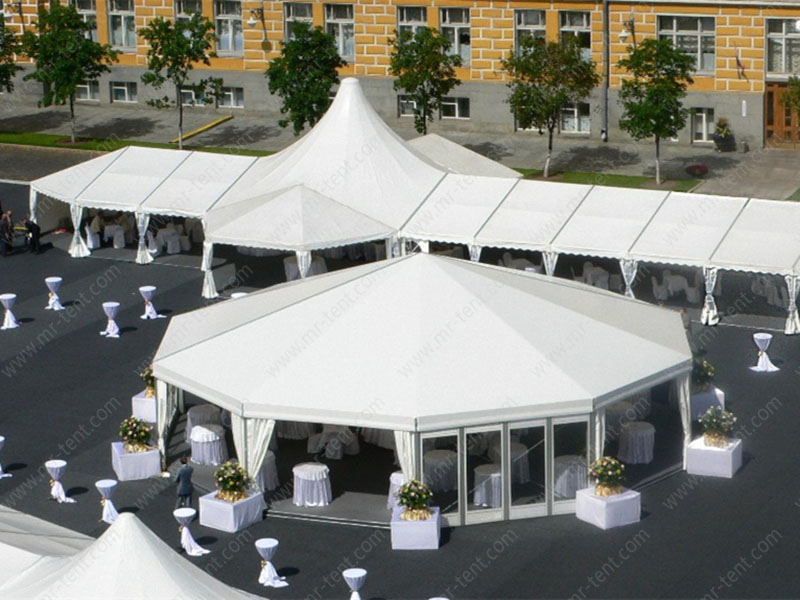
Multi-side Tent
Multi-side Tent is a temporary or semi permanent building structure constructed using modular design concepts, named after its unique geometric shape and flexible panel combination. Unlike traditional square tents, Multi-side Tents create both beautiful and practical architectural spaces through the clever combination of multiple planes (usually triangles, pentagons, hexagons, etc.).
In terms of structural features, Multi-side Tents are usually composed of the following core components:
Framework system: High strength aluminum alloy or steel main beams are used, and multi angle stable combination is achieved through precision designed connection nodes. Modern Multi-side Tents commonly adopt a "welding free" design, with all connections fixed with bolts, ensuring structural strength and facilitating disassembly and assembly.
Covering materials: Various materials such as PVC tarpaulin, polycarbonate sheet, glass curtain wall, or metal sheet can be selected according to needs. The advanced model is also equipped with double-layer insulation cover, and the inner layer can be added with insulation cotton to adapt to different climate conditions.
Basic fixation: Provides various foundation solutions, including concrete counterweights, spiral piles, expansion bolt fixation, etc., to ensure stability under various geological conditions.
Auxiliary system: Integrated drainage design, ventilation system, and electrical wiring channels make the tent not only aesthetically pleasing but also have comprehensive practical functions.
Types and specifications of Multi-side Tents
Modern Multi-side Tents have developed a variety of types to meet the needs of different scenarios:
Classified by shape:
Dome shaped tent: a spherical or hemispherical structure composed of multiple triangular panels that can achieve large spans without internal support
Prism shaped tent: a cylindrical structure composed of repeated pentagonal or hexagonal units, suitable for long corridor space requirements
Composite tent: creatively combining different geometric shapes to form a unique architectural appearance
According to size specifications:
Small multi-faceted tent (50-100 square meters): suitable for boutique exhibitions, outdoor cafes and other scenes
Medium sized Multi-side Tent (100-500 square meters): suitable for enterprise activities, temporary warehouses, and other purposes
Large Multi-side Tents (over 500 square meters): can meet the needs of large-scale events such as sports events and music festivals
According to the usage cycle:
Temporary type (1-3 months): using lightweight materials for quick construction and disassembly
Semi permanent (6 months -5 years): Reinforced structural design to withstand harsh weather conditions
Permanent type (over 5 years): Combined with fixed building standards, achieve long-term use
The advantages and application value of Multi-side Tents
The reason why Multi-side Tents have rapidly become popular in recent years is due to their unique comprehensive advantages:
Structural advantages:
Geometric stability: The polyhedral structure has an increased wind resistance of over 40% compared to traditional rectangular structures
Space efficiency: Column free design can achieve a space utilization rate of over 85%
Lighting performance: Multi angle panel design ensures even distribution of natural light and reduces lighting energy consumption
Functional advantages:
Quick deployment: A professional team can complete the construction of a 500 square meter tent within 8 hours
Scalability: Modular design supports seamless splicing and expansion
Environmental adaptation: Special coating treatment can resist extreme temperatures ranging from -30 ℃ to 50 ℃
The application scenarios are becoming increasingly widespread:
Business field: Luxury pop-up stores and car showrooms use Multi-side Tents to enhance brand image
Cultural and Sports Activities: As a temporary sports arena and main stage for music festivals, providing a unique visual experience
Emergency relief: Tent communities with medical and material distribution functions can be established within 48 hours after the disaster
Industrial use: As a temporary factory or storage center, it solves the problem of insufficient space during peak production seasons
Agricultural Innovation: As a high-tech greenhouse, the multi-faceted structure optimizes the distribution of light and air circulation
Precautions for selection and construction
Choosing a suitable Multi-side Tent requires consideration of multiple factors:
Venue evaluation:
Measure the available area and terrain characteristics
Understand the maximum wind speed and snowfall records in the local area
Confirm the distribution of underground pipelines
Requirement analysis:
Estimate the number of people that can be accommodated simultaneously
Determine equipment placement requirements
Consider special functional requirements (such as constant temperature, sound insulation, etc.)
Key points for supplier selection:
Check the structural calculation sheet and wind tunnel test report
Understand the fire rating of the material (at least reaching B1 level)
Confirm the after-sales service content and response time
Key control points during the construction process:
The basic construction error needs to be controlled within ± 5mm
Framework assembly should follow the principle of "expanding from the center to the outside"
The tension of the tarpaulin needs to be tested using a dedicated tension meter (standard value is 200-250N)
Finally, conduct a 48 hour load test before putting it into use
In terms of maintenance, it is recommended to check the fastening of structural connectors once every quarter, professionally clean and UV resistant the tarpaulin every year, and conduct safety assessments immediately after extreme weather conditions.