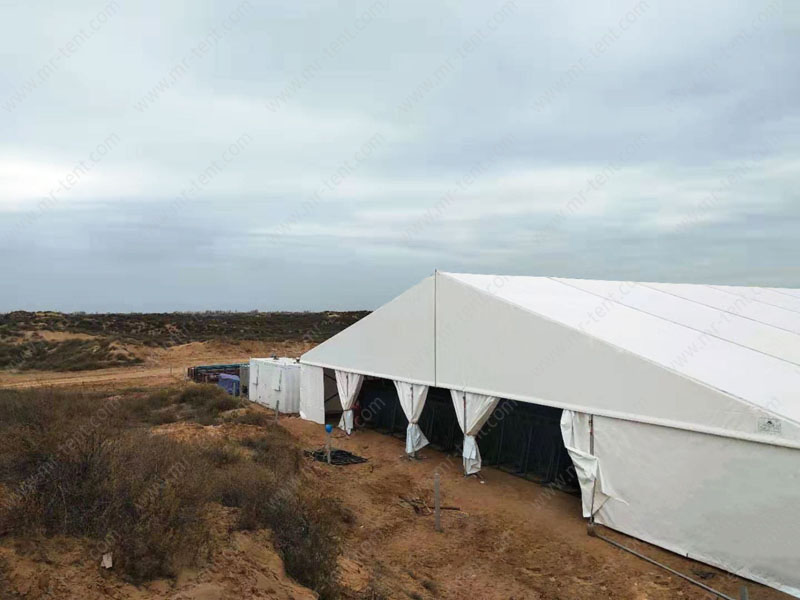
Environmental Protection Tent
Environmental Protection Tents are an innovative temporary construction solution that has emerged in recent years, perfectly combining practicality and environmentally friendly concepts. Compared with traditional steel structure temporary buildings, eco-friendly tents adopt lightweight design and renewable materials, significantly reducing the carbon footprint during the construction process. This structure achieves rapid construction and dismantling through modular design, suitable for various short-term activities, emergency shelters, or temporary workplaces, while minimizing the impact on the environment.
Modern eco-friendly tents have developed diverse types to meet different needs: from fully recyclable aluminum alloy frame tents to tarpaulins made from recycled plastic fibers; From energy self-sufficient tents equipped with solar panels to climate adaptive tents using special insulation materials. These innovative designs not only provide comfortable temporary spaces, but also represent an important step in the construction industry's transition towards sustainable development.
The core characteristics of Environmental Protection Tents
Material Innovation and Sustainability
The material selection of eco-friendly tents reflects the principle of circular economy. The frame is generally made of high-strength aluminum alloy, which is not only lightweight and durable, but also has 100% recyclability. The aluminum material that is remelted after recycling can maintain its original performance and only requires 5% of the energy produced from the original aluminum. The materials for tarpaulins are more diverse: some use recycled polyester fibers made from recycled plastics from the ocean, which can consume the equivalent of 50 plastic bottles of waste plastic per square meter of tarpaulin; Some use bio based materials such as bamboo fiber composite materials, which have natural antibacterial and biodegradable properties; Some innovative products adopt new coating technology, which enables the tarpaulin to have self-cleaning function, reducing the use of cleaning water and chemical cleaning agents.
The environmental certification of materials is also an important consideration, and leading eco-friendly tent products have generally obtained OEKO-TEX certification ® Standard 100、Cradle to Cradle Certified ® Wait for international certification to ensure that the entire lifecycle from raw material acquisition to final processing meets strict environmental standards.
Energy conservation and efficient utilization of resources
Environmental Protection Tents have shown outstanding performance in terms of energy efficiency. The structural design adopts aerodynamic shape to reduce wind resistance, and the double-layer tarpaulin structure forms a heat-insulating air layer. It can reduce the internal temperature by 3-5 ℃ in summer and reduce heat loss by more than 30% in winter. The transparent tarpaulin commonly uses ETFE film material, which has a light transmittance of up to 95% and blocks 99% of ultraviolet rays, greatly reducing the need for daytime lighting.
Many high-end eco-friendly tents have integrated renewable energy systems: flexible solar thin-film cells are installed on the top of the tent, and the daily electricity generation per 100 square meters of the tent can reach 20-30 kWh; Edge configuration of vertical axis wind turbines, utilizing wind energy from any direction; Some models are also equipped with rainwater collection and purification systems, which filter the rainwater from the canopy and use it for cleaning or sanitation purposes, achieving water resource recycling.
Intelligent Environmental Management System
Modern eco-friendly tents have developed into "smart eco-friendly spaces" that integrate multiple digital technologies to optimize resource utilization. The IoT sensor network monitors real-time internal temperature and humidity, air quality, energy consumption, and other data. Based on this, artificial intelligence algorithms automatically adjust ventilation systems, shading devices, and lighting brightness to minimize energy consumption while ensuring comfort.
The intelligent management system also includes carbon footprint tracking function, which accurately calculates the carbon emissions of the entire process from tent construction to demolition, and generates visual reports. Some systems even link to carbon trading platforms, automatically purchasing carbon credits to achieve operational carbon neutrality. Mobile applications allow users to view environmental performance at any time, enhancing their sense of participation and responsibility.
Environmental Protection Tents represent a paradigm shift in the field of temporary construction, proving that human activities can meet various spatial needs without sacrificing environmental quality. With technological innovation and policy support, this sustainable solution will play an increasingly important role in urban construction, disaster management, and the activity industry, making substantial contributions to achieving carbon neutrality goals.