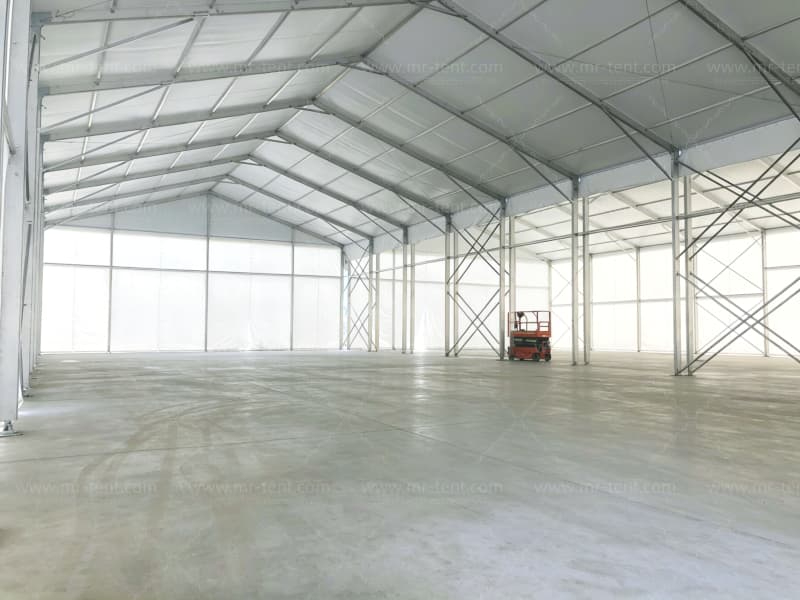
China Warehouse Tent
Warehouse tents have emerged as a practical and flexible industrial storage solution, widely adopted by various industries to address temporary and semi-permanent space shortages. Unlike traditional brick-and-mortar warehouses that require long construction cycles and fixed site investment, these modular tent structures feature lightweight frames and durable fabric enclosures, delivering rapid deployment and adaptable spatial layouts. Designed to meet diverse industrial storage, logistics transit, and production auxiliary needs, they balance structural stability, environmental adaptability, and cost efficiency. Suitable for seasonal inventory expansion, short-term project storage, and emergency space supplementation, modern warehouse tents integrate optimized material technology and structural design to resist harsh outdoor conditions. They have become a vital supplementary facility for modern industrial supply chains, helping enterprises optimize space utilization and improve operational flexibility in dynamic market environments.
The core competitiveness of warehouse tents lies in their highly flexible modular structural design, which fundamentally breaks the spatial limitations of traditional fixed buildings. Adopting a clear-span internal layout, these tents eliminate intermediate support poles, enabling 100% utilization of the internal floor space and providing unobstructed areas for stacking goods, placing mechanical equipment, and vehicle passage. All frame components are standardized and serialized, allowing free combination and flexible adjustment of length, width, and height according to actual usage scenarios. Whether enterprises need small independent storage spaces for spare parts or large-scale expansive venues for bulk cargo storage, the modular system can complete personalized layout matching. Moreover, the split assembly structure allows rapid construction and convenient disassembly without complicated construction procedures or permanent ground transformation. After completing short-term usage demands, the tents can be disassembled, transported, and reassembled at new sites, realizing repeated cyclic utilization and greatly enhancing the mobility of industrial space resources.
Material selection determines the excellent performance and long service life of warehouse tents, with both frame and enclosure materials undergoing rigorous industrial optimization. The supporting frames are made of high-strength lightweight alloy materials, which possess outstanding compressive resistance, corrosion resistance, and deformation resistance. This material effectively avoids rust, bending, and damage caused by long-term outdoor exposure, maintaining stable structural performance in complex environments. The outer enclosure adopts thickened industrial-grade PVC fabric, processed with special technical treatments to achieve excellent waterproof, sun-proof, UV-resistant, and dust-proof effects. The dense fabric structure can effectively block rainwater infiltration and prevent sunlight aging damage to internal goods, while isolating external dust and impurities to keep the storage environment clean. In addition, the fabric has good temperature adaptability, maintaining stable physical properties in extreme high and low temperature environments, ensuring normal use of the tent in different seasonal and regional climatic conditions.
Warehouse tents exhibit remarkable environmental adaptability and weather resistance, capable of stable operation in diverse outdoor and semi-outdoor scenarios. Professionally optimized structural stress design enables the tents to withstand strong winds, accumulated snow, and severe temperature changes, avoiding structural collapse or deformation under extreme weather conditions. The tight sealing design of the tent body effectively isolates external climatic interference, creating a relatively independent and stable internal storage space. For high-temperature seasons, the breathable and heat-insulating properties of the fabric and optional ventilation accessories can reduce internal heat accumulation and avoid excessive temperature affecting the storage quality of temperature-sensitive goods. In rainy and humid environments, the fully waterproof structure and ground edge sealing design prevent moisture penetration, effectively reducing the humidity inside the tent and avoiding goods mildew and corrosion. Whether used in open-air industrial parks, logistics yards, or temporary construction sites with complex terrain, the tents can adapt to various site conditions without special ground foundation treatment, greatly expanding their application scenarios.
Compared with traditional fixed warehouse buildings, warehouse tents have obvious operational and economic advantages, bringing flexible asset management solutions for enterprises. The construction cycle of warehouse tents is extremely short, taking only a few days to complete assembly and put into use, which can quickly respond to sudden space demand surges such as peak inventory seasons and temporary order increases, effectively solving the problem of insufficient enterprise storage capacity. In terms of cost input, tent structures avoid the high expenses of traditional building design, foundation construction, and long-term maintenance, with lower overall investment and no long-term fixed asset pressure. Enterprises can flexibly arrange construction scale and usage cycle according to business conditions, realizing on-demand space deployment. Meanwhile, the later maintenance of warehouse tents is simple and convenient; local damaged fabrics or frame parts can be independently replaced without overall renovation, greatly reducing daily operation and maintenance costs and improving the economic benefits of enterprise space management.
With rich expandable accessory configurations, warehouse tents can be upgraded into multifunctional comprehensive venues to meet refined industrial usage needs. According to different storage and operation requirements, various supporting facilities can be freely matched and installed. For daily access and management, different types of doors including rolling shutter doors, double-wing doors, and thermal insulation doors are optional, facilitating the passage of personnel, forklifts, and transport vehicles. For lighting and ventilation demands, transparent lighting windows and professional ventilation systems can be configured to improve internal light brightness and air circulation, solving the problems of dark light and stuffy air in closed storage spaces. In terms of safety management, targeted supporting configurations can be added to optimize the internal operation environment. In addition, optional ground systems, external rain gutters, and thermal insulation wall panels can further improve the comfort and practicality of the tent, enabling it to meet not only conventional storage needs but also temporary workshop, sorting operation, and office auxiliary usage scenarios.
Warehouse tents play an irreplaceable supporting role in multiple industrial scenarios, empowering the efficient operation of diverse industries. In the logistics and warehousing industry, they serve as temporary turnover warehouses and peak reserve spaces, effectively relieving the storage pressure of fixed warehouses during order concentration periods and improving the turnover efficiency of goods. In the manufacturing industry, they can be used as temporary material stacking areas, semi-finished product storage spaces, and equipment placement venues, solving the problem of insufficient factory internal space and ensuring the continuity of production operations. In engineering construction and emergency support scenarios, warehouse tents can be quickly deployed as on-site material warehouses and tool storage rooms, providing safe and reliable storage guarantees for engineering materials. In addition, they are also widely used in agricultural product storage, commodity temporary storage, and outdoor project supporting spaces, with strong scenario compatibility to meet the differentiated space demands of different industries.
As the industrial market continues to develop towards flexibility and high efficiency, warehouse tents are becoming an indispensable part of modern industrial space systems with their unique advantages. The continuous upgrading of material technology and structural design is further improving the comprehensive performance of warehouse tents, making their stability, durability, and comfort continuously optimized to adapt to increasingly complex industrial usage environments. Their flexible disassembly and assembly, reusable characteristics, and low-cost investment model perfectly fit the lightweight operation needs of modern enterprises, helping enterprises reduce operational risks and improve market response speed. In the future, with the continuous innovation of personalized customization and functional supporting systems, warehouse tents will gain broader application space, provide more diversified and efficient space solutions for global industrial development, and continuously release new industrial value.